By Lisa Nyakato Ankunda
Access to justice remains a fundamental pillar of the rule of law and an essential safeguard for the protection of women’s rights. Across Uganda, thousands of women experience violence within their homes, yet they never see justice. According to the Uganda Bureau of Statistics (UBOS) in the Uganda Demographic and Health Survey, around 56% of women aged 15–49 have experienced physical violence and nearly 22% have experienced sexual violence in their lifetime. While the country has adopted progressive legal frameworks intended to protect women, the reality within the justice system often tells a different story.
Uganda’s legal framework recognizes the rights of women and provides mechanisms for protecting women. The Constitution of the Republic of Uganda guarantees equality before the law and obligates the state to protect the dignity and welfare of women. Article 33 specifically emphasizes the rights of women and calls for the protection of their interests in society. The Domestic Violence Act,2010; Penal Code Act and Children Act,2016 further which provide safeguards to protect victims.
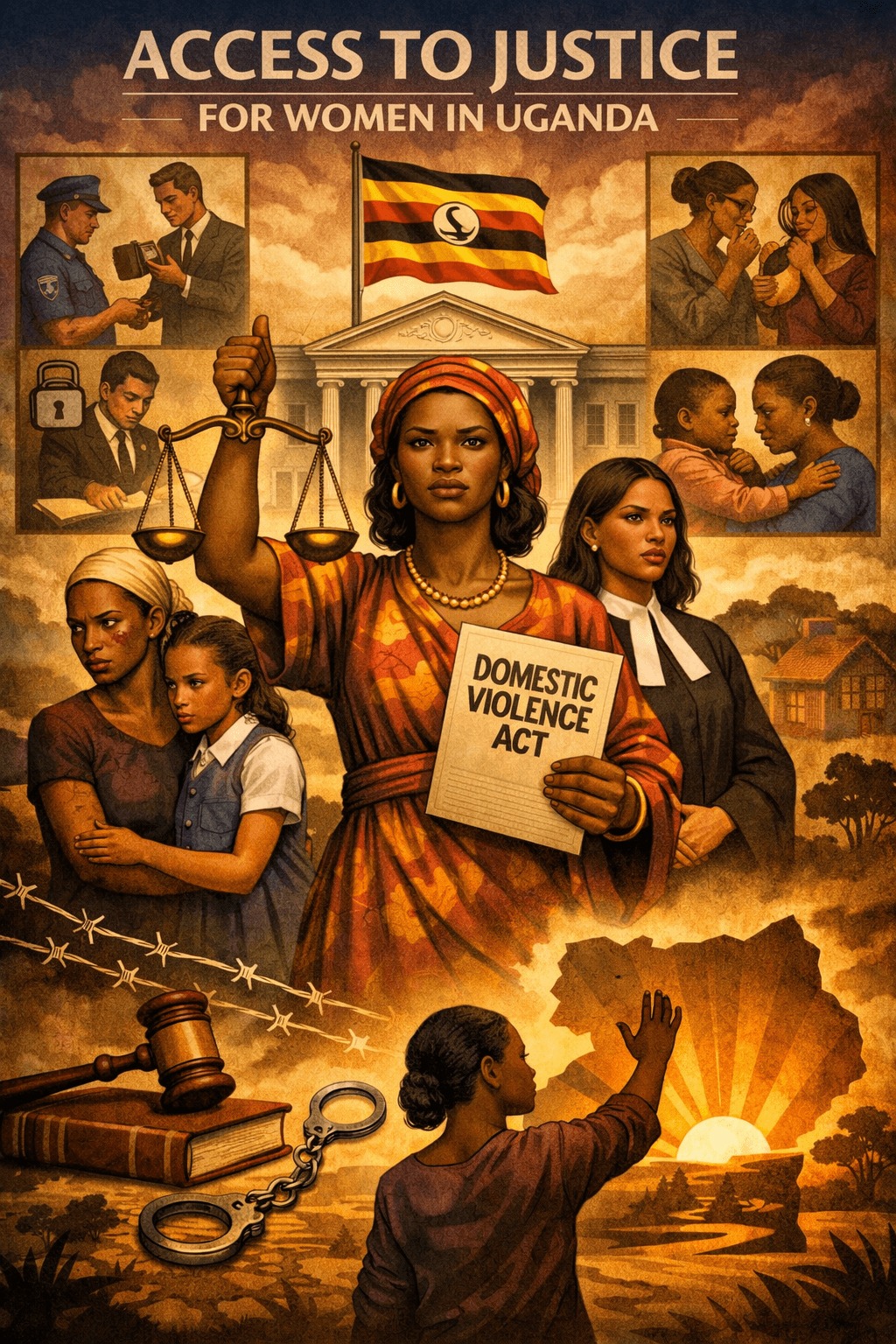
In particular, the Domestic Violence Act, 2010 was enacted to prohibit abuse within domestic relationships, empower courts to issue protection orders and provide compensation to victims. Yet more than a decade after its enactment, many women who experience domestic violence continue to face profound challenges in accessing justice through the formal legal system. Despite growing awareness and the existence of laws, many survivors still struggle to obtain justice through the legal system. The existence of these laws has not automatically translated into effective access to justice.
Many survivors of gender-based violence still struggle to navigate the justice system due to social stigma, economic dependence and corrupt practices within some law enforcement institutions, where victims may be asked to pay informal fees to have their complaints recorded or investigations pursued, thereby limiting their ability to access justice. As a result, the law that was designed to protect women often remains underutilized, raising serious questions about whether Uganda’s legal framework is truly delivering justice for survivors of domestic violence. In addition, survivors face barriers when attempting to report abuse and while in pursuit of legal action due to corruption and informal payments within the justice institutions which silences many victims.
Recent reports according to CPAR Uganda show that although thousands of domestic violence cases are reported annually, very few reach the courts. For example, about 14,073 domestic violence cases were reported to police between 2024-2025 and only 10.7% (1502 cases) reached court, of which some of those many remain pending. The gap reported between incidents and court proceedings shows that many cases are resolved informally at the police level or through family mediation.
A review of reported decisions on the Uganda Legal Information Institute reveals very few cases in which the Domestic Violence Act,2010 is directly applicable. Most cases are prosecuted under general criminal provisions under the Penal Code rather than relying on the Domestic Violence Act,2010. This shows how the Act itself is rarely the primary legal tool used in court.
There are several factors that contributed to this including that women face pressure from family or community members to resolve disputes rather than involving legal action due to social stigma. Many survivors rely financially on their abusers, making it difficult to pursue legal proceedings. Studies suggest that even some justice sector actors are not fully aware of the provisions under the Domestic Violence Act, 2010 and lastly delays in court processes, inadequate legal aid and limited specialized training for law enforcement officers can further discourage survivors from pursuing justice.
The major untold significant barrier to justice is corruption within the justice system. In some cases, victims are required to make informal payments in order to have their cases investigated, recorded or pursued by authorities leading to survivors without financial resources constrained. These informal costs create an additional obstacle that discourages them from pursuing legal remedies. Thus, when justice becomes dependent on the ability to pay bribes or facilitation fees, the system excludes survivors who are already in vulnerable positions.
Addressing gender based violence in Uganda requires more than laws. It requires a justice system that is accessible and free from corruption. Strengthening access to justice will require improved accountability within the law enforcement institutions, greater awareness of legal rights regarding domestic violence and corruption especially in rural areas and expanded access to legal aid services. This requires increasing awareness of the Domestic Violence Act, 201 among both rural and urban justice sector actors and the public to strengthen legal aid services for survivors. Furthermore, specialized trainings for law enforce officers and judicial officers especially in mediation could improve the handling of domestic violence cases and ensure the survivors receive the protection envisioned under the law.
The Writer is a Programme Associate at DEI